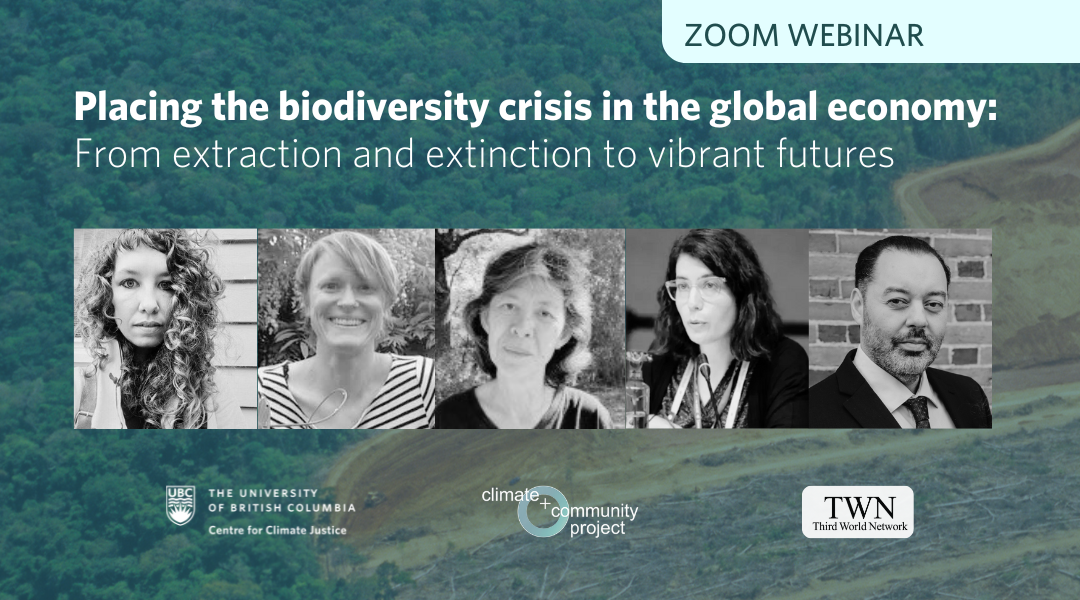
We are at a critical juncture. Our current political and econom ic systems\, built primarily around extraction\, are driving compounding cr ises of inequity\, climate change\, and biodiversity loss. For decades\, wo rld leaders and policymakers have known these crises are escalating\, but h ave done little to prevent it. Why is this?
New research from the Centre for Climate Justice\, the Clim ate and Community Project\, and Third World Network tries to answer this qu estion\, finding that governments are “exporting extinction” under pressure from an unequal international financial system. That is\, while many governments continue to support extracti ve sector expansion with domestic policies\, their policy autonomy to imple ment a just and ecological transition is highly constrained by conditions o f financial and political subordination.
These constraints must be overcome for the world’s governments to meet environmental commitments. With upcoming major UN conferences on b iodiversity and climate hosted by Colombia and Brazil\, respectively\, bold action for climate and ecosystems\, as well as international solidarity an d redistributive agendas\, will be on the table. Colombia’s Minister of Env ironment and Sustainable Development\, Susana Muhamad\, was quoted in The Guardian : “Although the climate is affecting biodiversity\, nature is an answer to the climate crisis. It is not the only answer but it is a very important pi llar and we want to position it very strongly to build towards Cop30 in Bra zil.”
With these two major\, fast-approaching opportunities to redirect international policy and agreem ents toward solving compounding ecological crises\, we know there is more w ork to do to ensure the right solutions are adopted\, and a necessary break with the status quo of extractivism is achieved.
Join the Centre for Climate Justice\, the Climate and Community Project\, and Third World Network for a Zoom webinar at 09:00 PDT/112:00 EDT/16:00 UTC on Tues day 7 May 2024 to learn more about new\, leading research on these issues a nd what you can do to seize the opportunities for change ahead.
 Thea Riofrancos is an Associate Professor of Political S
cience at Providence College\, an Andrew Carnegie Fellow (2020-2022)\, and
a member of the Climate + Community Project. Her research focuses on resour
ce extraction\, renewable energy\, climate change\, green technology\, soci
al movements\, and the left in Latin America. These themes are explored in
her book\, Resource Radicals: From Petro-Nationalism to Post-Extractivis
m in Ecuador (Duke University Press\, 2020)\, as well as in peer
-reviewed articles in Perspectives on Politics\, Cultural Studies
\, World Politics\, and Global Environmental Politics (fo
rthcoming)\, essays that have appeared in outlets such as The New York T
imes\, The Washington Post\, Foreign Policy\, The Guar
dian\, n+1\, Dissent\, Jacobin and NACLA\, and in her coauthored
book\, A Planet to Win: Why We Need a Green New Deal (Verso Books\,
2019). She is currently writing a book titled Extraction: The Frontiers
of Green Capitalism\, with W.W. Norton.
Thea Riofrancos is an Associate Professor of Political S
cience at Providence College\, an Andrew Carnegie Fellow (2020-2022)\, and
a member of the Climate + Community Project. Her research focuses on resour
ce extraction\, renewable energy\, climate change\, green technology\, soci
al movements\, and the left in Latin America. These themes are explored in
her book\, Resource Radicals: From Petro-Nationalism to Post-Extractivis
m in Ecuador (Duke University Press\, 2020)\, as well as in peer
-reviewed articles in Perspectives on Politics\, Cultural Studies
\, World Politics\, and Global Environmental Politics (fo
rthcoming)\, essays that have appeared in outlets such as The New York T
imes\, The Washington Post\, Foreign Policy\, The Guar
dian\, n+1\, Dissent\, Jacobin and NACLA\, and in her coauthored
book\, A Planet to Win: Why We Need a Green New Deal (Verso Books\,
2019). She is currently writing a book titled Extraction: The Frontiers
of Green Capitalism\, with W.W. Norton.
 Je
ssica Dempsey is an Associate Professor in the Department of Geogr
aphy and Associate Head of Undergraduate Programs at the University of Brit
ish Columbia. Her research and teaching focus on environmental politics. In
geography this often goes under the label of political ecology\, which ref
ers to much more than the government or the state. It includes consideratio
n of how environmental politics is shaped by and shapes economics\, science
\, culture\, history\, gender\, racism\, colonialism\, social movements and
more. Her current major research projects focus on 1) developing a politic
al economic explanation of extinction\, centered on an investigation of Can
adian wildlife\, and 2) examining dominant\, increasingly economic and fina
ncial approaches to conservation. Her research is in dialogue with diverse
methodologies and literatures\, including political ecology\, feminist poli
tical economy\, economic geography\, science studies\, and green finance.
Je
ssica Dempsey is an Associate Professor in the Department of Geogr
aphy and Associate Head of Undergraduate Programs at the University of Brit
ish Columbia. Her research and teaching focus on environmental politics. In
geography this often goes under the label of political ecology\, which ref
ers to much more than the government or the state. It includes consideratio
n of how environmental politics is shaped by and shapes economics\, science
\, culture\, history\, gender\, racism\, colonialism\, social movements and
more. Her current major research projects focus on 1) developing a politic
al economic explanation of extinction\, centered on an investigation of Can
adian wildlife\, and 2) examining dominant\, increasingly economic and fina
ncial approaches to conservation. Her research is in dialogue with diverse
methodologies and literatures\, including political ecology\, feminist poli
tical economy\, economic geography\, science studies\, and green finance.
 Chee Yoke Li
ng is a lawyer with degrees from the University of Malaya and the
University of Cambridge. She is Executive Director of Third World Network\,
an international non-profit policy research and advocacy organization with
its secretariat in Malaysia. She works on sustainable development issues\,
with a focus on social justice and equity issues and the effects of global
ization on developing countries. She has engaged actively with civil societ
y groups and developing country government policy makers in the evolution o
f sustainable development principles and actions since the 1992 United Nati
ons Conference on Environment and Development in Rio de Janeiro to the 2030
Agenda for Sustainable Development. Among her current research and advocac
y work are issues related to trade and investment\, public health especiall
y access to affordable treatment\, ecological agriculture and farmers’ righ
ts. She is also on the Board of International Women’s Rights Action Watch A
sia-Pacific (IWRAW-Asia Pacific)\, and the Executive Committee of Sahabat A
lam Malaysia (Friends of the Earth\, Malaysia).
Chee Yoke Li
ng is a lawyer with degrees from the University of Malaya and the
University of Cambridge. She is Executive Director of Third World Network\,
an international non-profit policy research and advocacy organization with
its secretariat in Malaysia. She works on sustainable development issues\,
with a focus on social justice and equity issues and the effects of global
ization on developing countries. She has engaged actively with civil societ
y groups and developing country government policy makers in the evolution o
f sustainable development principles and actions since the 1992 United Nati
ons Conference on Environment and Development in Rio de Janeiro to the 2030
Agenda for Sustainable Development. Among her current research and advocac
y work are issues related to trade and investment\, public health especiall
y access to affordable treatment\, ecological agriculture and farmers’ righ
ts. She is also on the Board of International Women’s Rights Action Watch A
sia-Pacific (IWRAW-Asia Pacific)\, and the Executive Committee of Sahabat A
lam Malaysia (Friends of the Earth\, Malaysia).
 Ana Di Pangracio is a lawyer (Universi
ty of Buenos Aires 2005)\, specialized in Environmental Law (Argentine Cath
olic University 2010). She has a postgraduate course in Gender and Law (Uni
versity of Buenos Aires´s Law School 2020). She was granted a semester exch
ange scholarship by the Linnaeus-Palme Program (MSc. Environmental Manageme
nt and Policy at IIIEE-Lund University 2010) and she is alumni of the Inter
national Visitor Leadership Program of the US State Department (2016). She
has fifteen years´ experience working on socioenvironmental matters. Since
2010 she is Biodiversity Coordinator at Fundación Ambiente y Recursos Natur
ales (FARN)\, based in Buenos Aires\, Argentina. Since 2013 she is also its
Deputy Director. She is a member of the CBD Women's Caucus and takes part
in the CBD Alliance (an NGO participation mechanism and network within the
CBD process). She also follows regional processes such as the Escazú Agreem
ent on access to information\, public participation and justice in environm
ental matters in Latin America and the Caribbean. She is currently an elect
ed IUCN Councillor for South America and Mesoamerica 2021-2025. She is a me
mber of IUCN´s WCEL\, CEESP and WCPA. She was President of the IUCN South A
merican Committee 2017-2019 and Coordinator of the Argentine IUCN Committee
2015-2021. She was Vice-President of the Forum for the Conservation of the
Patagonian Sea 2016-2019. She has been a permanent and invited lecturer at
the Law School and Faculty of Exact and Natural Sciences of the University
of Buenos Aires\, University of Palermo (Argentina)\, University of Salvad
or\, the Argentine Catholic University and the Buenos Aires Technological I
nstitute. Previously\, Ana has worked for other NGOs and as an environmenta
l consultant. She is an avid birdwatcher and naturalist.
Ana Di Pangracio is a lawyer (Universi
ty of Buenos Aires 2005)\, specialized in Environmental Law (Argentine Cath
olic University 2010). She has a postgraduate course in Gender and Law (Uni
versity of Buenos Aires´s Law School 2020). She was granted a semester exch
ange scholarship by the Linnaeus-Palme Program (MSc. Environmental Manageme
nt and Policy at IIIEE-Lund University 2010) and she is alumni of the Inter
national Visitor Leadership Program of the US State Department (2016). She
has fifteen years´ experience working on socioenvironmental matters. Since
2010 she is Biodiversity Coordinator at Fundación Ambiente y Recursos Natur
ales (FARN)\, based in Buenos Aires\, Argentina. Since 2013 she is also its
Deputy Director. She is a member of the CBD Women's Caucus and takes part
in the CBD Alliance (an NGO participation mechanism and network within the
CBD process). She also follows regional processes such as the Escazú Agreem
ent on access to information\, public participation and justice in environm
ental matters in Latin America and the Caribbean. She is currently an elect
ed IUCN Councillor for South America and Mesoamerica 2021-2025. She is a me
mber of IUCN´s WCEL\, CEESP and WCPA. She was President of the IUCN South A
merican Committee 2017-2019 and Coordinator of the Argentine IUCN Committee
2015-2021. She was Vice-President of the Forum for the Conservation of the
Patagonian Sea 2016-2019. She has been a permanent and invited lecturer at
the Law School and Faculty of Exact and Natural Sciences of the University
of Buenos Aires\, University of Palermo (Argentina)\, University of Salvad
or\, the Argentine Catholic University and the Buenos Aires Technological I
nstitute. Previously\, Ana has worked for other NGOs and as an environmenta
l consultant. She is an avid birdwatcher and naturalist.
Fadhel Kaboub is an associate professor of econ
omics at Denison University (on leave)\, and the president of t
he Global Institute for Sustaina
ble Prosperity. He is also a me
mber of the Independent Expert G
roup on Just Transition and Development\, an expert group member with the International Taxation Task Force (created at COP28 and co-chaired by France\, Kenya\, and Barb
ados)\, and serves as senior advisor with Power Shift Africa. H
e has recently served as Under-Secretary-General for Financing for Developm
ent at the Organisation of South
ern Cooperation in Addis Ababa\
, Ethiopia. Dr. Kaboub is an expert on designing public policies to enhance
monetary and economic sovereignty in the Global South\, build resilience\,
and promote equitable and sustainable prosperity. His recent work focuses
on Just Transition\, Climate Finance\, and transforming the global trade\,
finance\, and investment architecture. His most recent co-authored publicat
ion is Just Transition: A Climate\, Energy\, and Development Vi
sion for Africa (May 2023\,
published by the Independent Expert Group on Just Transition and Developme
nt). He has held a number of research affiliations with the Levy Economics Institute (NY)\, the John F. Kennedy School of Government at Harvard University
